Kitchen Scales That Fit the Way You Meal Prep
A kitchen scale can be one of those small additions that quietly makes meal prep easier. Instead of estimating portions, measuring ingredients by volume, or using several different tools for different tasks, you can build weighing into the way you already cook.
But not every kitchen scale is designed around the same routine. Some are made for straightforward everyday prep, while others make sense if you want more detailed nutrition tracking, regularly work with very small quantities, or simply don’t want another bulky appliance taking up space.
We looked at five very different approaches to kitchen weighing and matched each one to the kind of meal-prep routine it can fit best.
Affiliate Disclosure: Some of the links below are affiliate links, which means FFN may earn a commission if you make a purchase through them, at no additional cost to you.
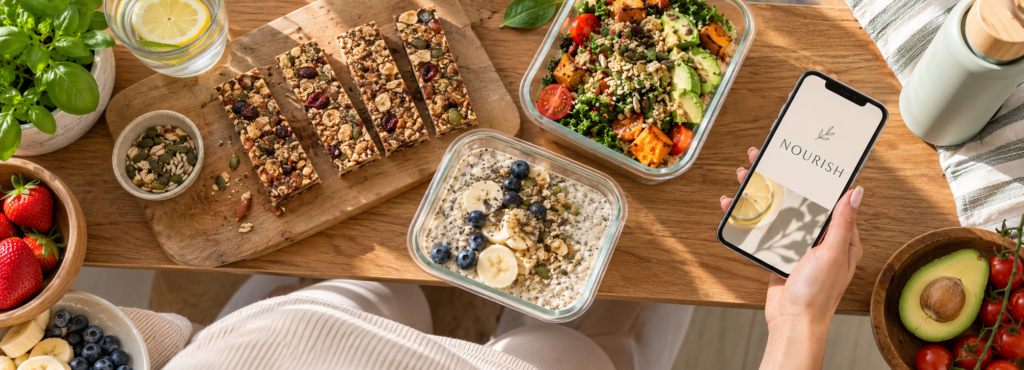
The right kitchen scale doesn’t have to be the one with the longest feature list. What matters more is how you actually use it.
For a simple meal-prep routine, a familiar digital scale with a useful capacity and tare function may be all you need. If you cook with very small quantities, however, finer measurements can become more relevant. And if your kitchen is short on storage space, a compact or folding design may make the difference between a tool you reach for regularly and one that ends up forgotten in a drawer.
That is why these five picks are not ranked from “best” to “worst.” Each one solves a slightly different everyday problem.
Shortlist
| Kitchen Scale | Best For | What Makes It Different |
|---|---|---|
| Amzmerit Smart Food Scale | Nutrition tracking that goes beyond the kitchen | Nutrition database, app connectivity, nutrient tracking and 0.1 g measurements |
| Maestri House Dual Platform Scale | Switching between everyday ingredients and small measurements | Two independent weighing platforms with different measurement increments |
| QFEISETH Self-Powered Kitchen Scale | A low-maintenance meal-prep routine | Generates its own power instead of relying on batteries or charging |
| Beewin Folding Kitchen Scale | Small kitchens and easy storage | Folding design that takes up less drawer or storage space |
| 3T6B Digital Measuring Spoon Scale | Small-quantity ingredients and fine measurements | Spoon-style design for weighing smaller amounts directly |
WHY THESE 5?
A good Decision Collection should make the choice easier, not simply give you five versions of the same product.
These scales stood out because they represent five genuinely different ways a kitchen scale can fit into an everyday cooking routine.
The Amzmerit takes weighing further into digital nutrition tracking. The Maestri House combines two weighing platforms for different measurement jobs. The QFEISETH focuses on eliminating batteries and charging altogether. The Beewin addresses the practical problem of storage, while the 3T6B takes a different approach to small quantities with its measuring-spoon format.
So the question isn’t simply Which scale is best?
It’s Which type of weighing fits the way you cook?
THE PICKS
1. Amzmerit Smart Food Scale
BEST FOR NUTRITION TRACKING THAT GOES BEYOND THE KITCHEN
If weighing ingredients is part of a more detailed nutrition-tracking routine, this is the most feature-rich option in the collection.
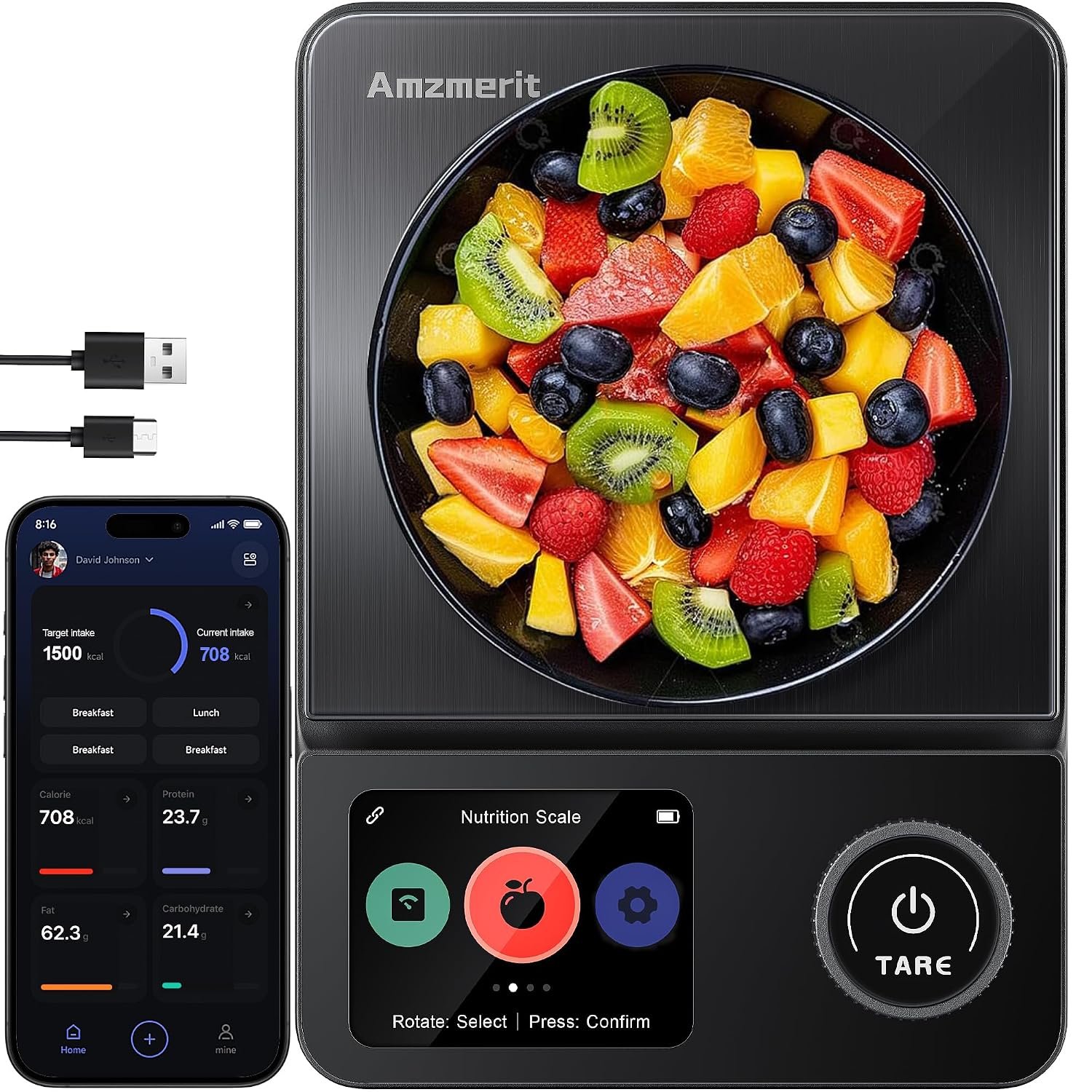
The Amzmerit combines a digital kitchen scale with nutritional information and app functionality. Its listing describes a database of more than one million foods, 19+ displayed nutrients, Bluetooth connectivity, a built-in timer and 0.1 g measurement increments. It measures from 0.3 g up to 5,000 g and supports units including grams, ounces, pounds, milliliters and fluid ounces.
MY PICK
Amzmerit Smart Food Scale
The Amzmerit combines a digital kitchen scale with nutritional information and app functionality. Its listing describes a database of more than one million foods, 19+ displayed nutrients, Bluetooth connectivity, a built-in timer and 0.1 g measurement increments.
Why We Like It
The interesting part here isn’t simply that it is a “smart” scale. It is that weighing can become part of a broader food-recording workflow.
For someone who already likes having nutrition information organized digitally, the combination of weighing, nutritional data and app functionality can make the scale feel less like a separate kitchen tool and more like part of the overall routine.
Things to Know
This is a more involved option than a basic kitchen scale. The nutrition and app features are the reason to choose it; if you simply want to weigh ingredients while cooking, you may not need all of that functionality.
It uses a rechargeable 800 mAh battery and USB-C charging.
2. Maestri House Dual Platform Kitchen Scale
BEST FOR SWITCHING BETWEEN EVERYDAY INGREDIENTS AND SMALL MEASUREMENTS
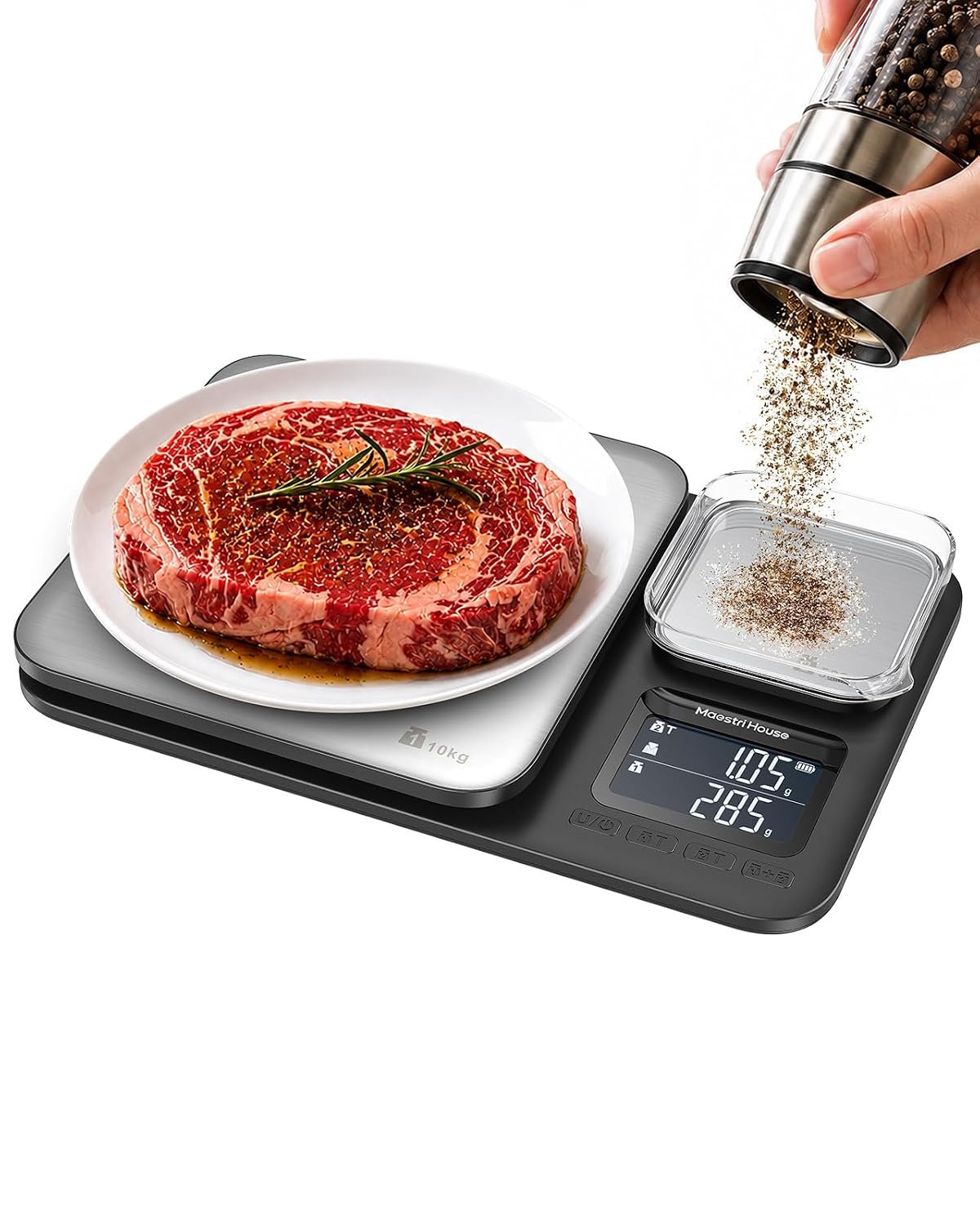
Some recipes ask you to weigh a bowl of flour, while others call for tiny quantities of spices, yeast or coffee. The Maestri House approaches those jobs differently by putting two independent weighing platforms into one scale.
The larger platform measures in 1 g increments, while the smaller platform measures in 0.01 g increments. The two platforms can also be used independently or combined when weighing.
MY PICK
Maestri House Dual Platform Kitchen Scale
The dual-platform design is the main reason to choose this model. It is more specialized than a straightforward kitchen scale, so its appeal depends on whether you will actually use both measurement ranges.
The scale also includes tare, multi-unit conversion, a backlit display and stainless-steel weighing platforms.
Why We Like It
This is a useful choice if your kitchen routine moves between very different types of ingredients.
Instead of switching between a conventional kitchen scale and a separate precision scale, you can use the appropriate platform for the task at hand.
That makes particular sense for someone who regularly bakes, experiments with recipes or works with both everyday and small-quantity ingredients.
Things to Know
The dual-platform design is the main reason to choose this model. It is more specialized than a straightforward kitchen scale, so its appeal depends on whether you will actually use both measurement ranges.
The scale also includes tare, multi-unit conversion, a backlit display and stainless-steel weighing platforms.
3. QFEISETH Self-Powered Digital Kitchen Scale
BEST FOR A LOW-MAINTENANCE MEAL-PREP ROUTINE
Meal prep already involves enough things to remember. This scale takes one small maintenance task out of the equation: batteries and charging.
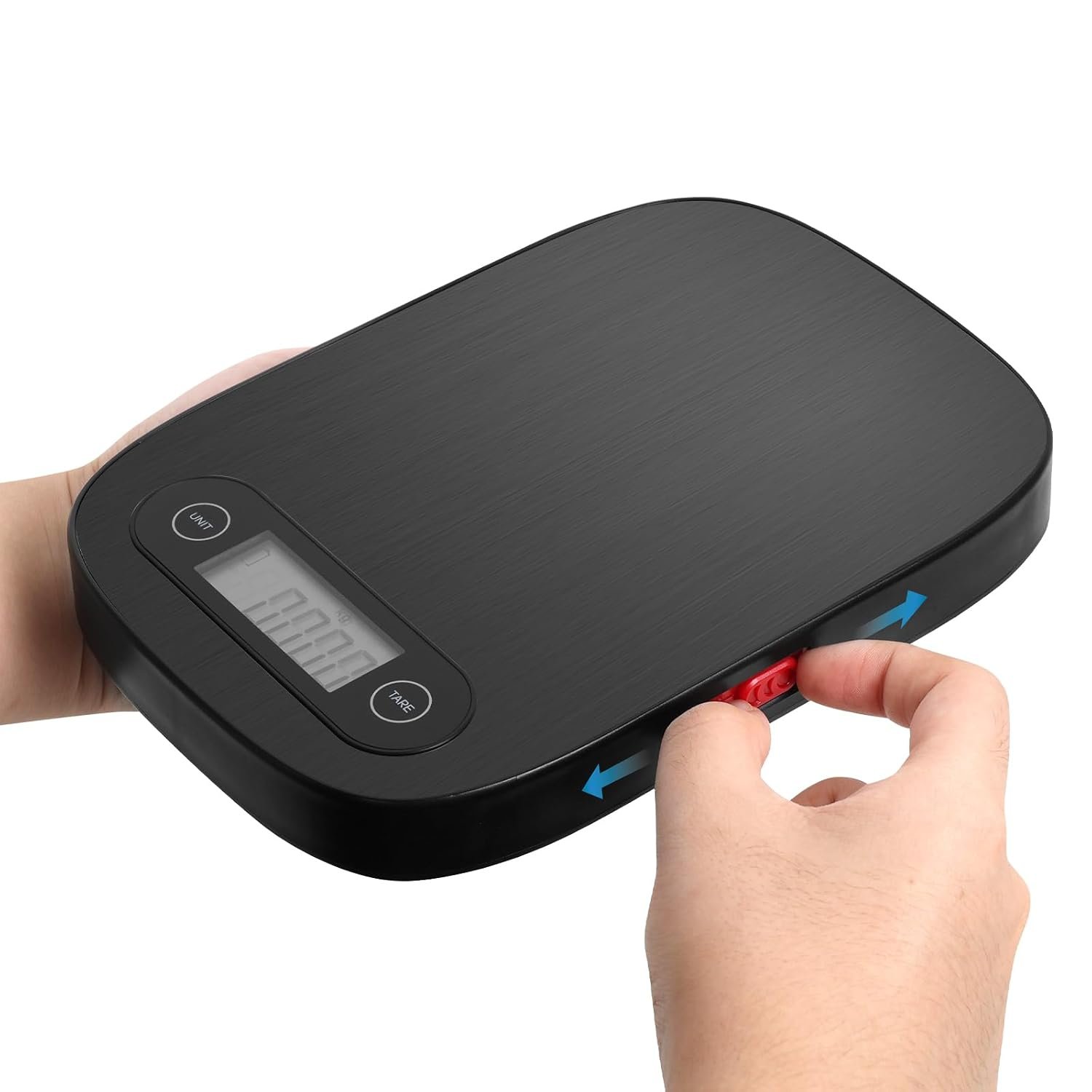
The QFEISETH scale generates power by sliding a side paddle before weighing, so it does not require replacement batteries or a charging cable. It has an 11 lb / 5 kg capacity, tare functionality and multiple measuring modes.
MY PICK
QFEISETH Self-Powered Digital Kitchen Scale
The scale generates power by sliding a side paddle before weighing, so it does not require replacement batteries or a charging cable. It has an 11 lb / 5 kg capacity, tare functionality and multiple measuring modes.
Why We Like It
The appeal is wonderfully straightforward.
If your ideal kitchen setup is one where tools are ready to use without wondering whether they need charging or whether there is a spare battery somewhere in the drawer, the self-powered design fits that philosophy.
It also supports one-bowl prep: place the bowl on the scale, tare it, and add ingredients one at a time.
Things to Know
The self-powered mechanism is the defining feature here. If you prefer rechargeable electronics or want advanced nutrition-tracking features, another option in this collection may be a better match.
The scale has a stainless-steel surface and is listed as 0.86 inches thick for slim storage.
4. Beewin Folding Digital Kitchen Scale
BEST FOR SMALL KITCHENS AND EASY STORAGE
Not everyone wants another kitchen gadget permanently occupying counter space.
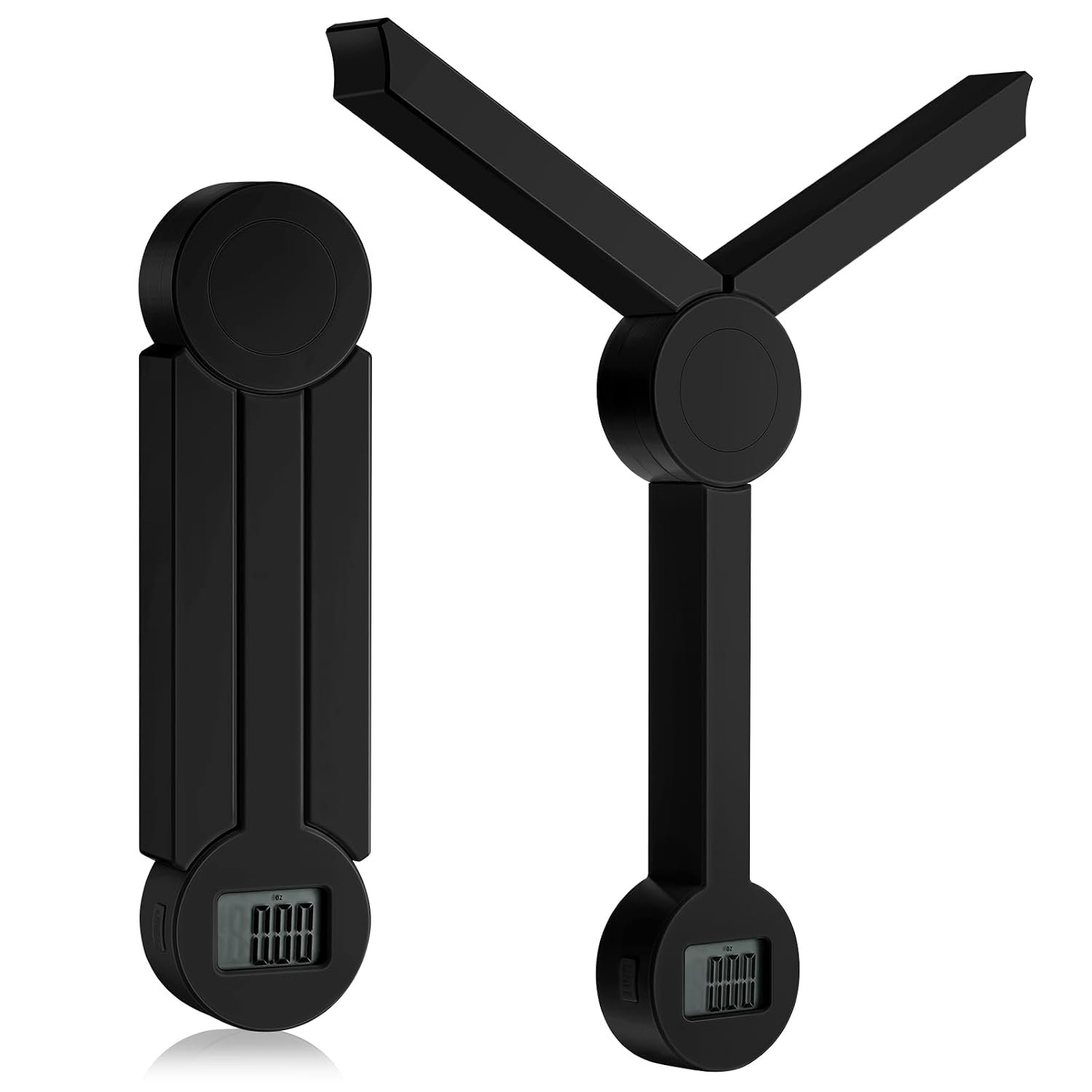
The Beewin is designed to fold into a compact form for storage in a drawer or cabinet. The listing also describes a tare function, automatic shutoff, five measurement units and a design intended for ingredients ranging from spices to flour.
MY PICK
Beewin Folding Digital Kitchen Scale
The Beewin is designed to fold into a compact form for storage in a drawer or cabinet. The listing also describes a tare function, automatic shutoff, five measurement units and a design intended for ingredients ranging from spices to flour.
Why We Like It
The strongest reason to choose this one is practical rather than technical: it is easier to put away.
That matters in a smaller kitchen, a shared kitchen, or simply for anyone who prefers clear counters between cooking sessions. A scale that can fold down and be stored easily can fit more naturally into that kind of routine.
Things to Know
The folding format is the key differentiator. This isn’t the pick for someone specifically looking for sophisticated nutrition tracking or multiple precision platforms.
It uses one CR2032 button battery, which is included according to the listing.
5. 3T6B Digital Measuring Spoon Scale
BEST FOR SMALL-QUANTITY INGREDIENTS AND FINE MEASUREMENTS
A traditional kitchen scale is useful for a bowl of vegetables, flour or other larger ingredients. But what happens when the quantity is small enough that a standard countertop scale feels unnecessarily large?
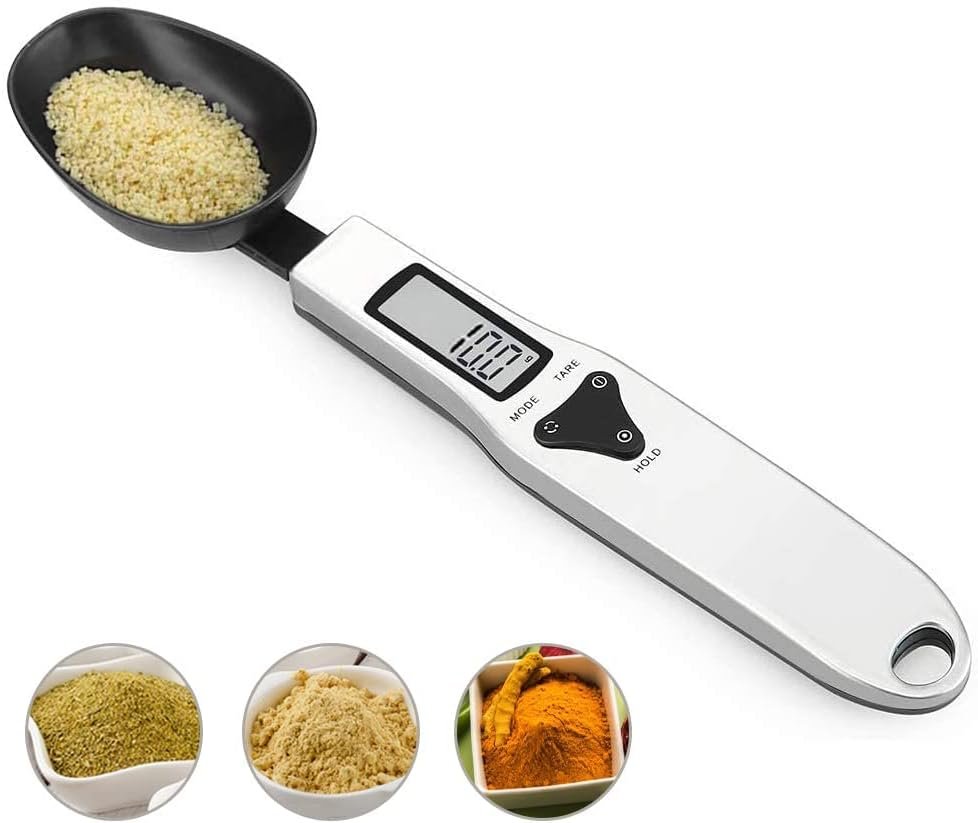
The 3T6B takes a different approach. It is a digital measuring spoon scale designed for smaller quantities, with tare, unit conversion and a reading-lock function. Its listing specifies measurement units including grams, ounces, grains and carats.
MY PICK
3T6B Digital Measuring Spoon Scale
The 3T6B takes a different approach. It is a digital measuring spoon scale designed for smaller quantities, with tare, unit conversion and a reading-lock function. Its listing specifies measurement units including grams, ounces, grains and carats.
Why We Like It
The spoon format makes sense for ingredients such as spices, tea, flour, butter or cream when you want to measure directly in the spoon rather than setting up a larger bowl on a countertop scale.
That makes it particularly interesting as a specialized small-quantity tool, rather than simply another version of a standard kitchen scale.
Things to Know
This is the most specialized format in the collection. It is designed around smaller quantities and requires the spoon to be held horizontally while weighing.
It uses two AAA batteries and has an automatic shutoff function.
Which one is right for your routine?
The easiest way to narrow these five down is to start with the situation you recognize yourself in.
You want weighing to connect with your nutrition-tracking routine
Its nutrition database, app functionality and detailed nutrient tracking make it the natural fit when weighing is part of a broader digital food-tracking workflow.
You regularly switch between large ingredients and very small quantities
→ Maestri House Dual Platform Scale
The two platforms let you move between everyday ingredients and more precise small-quantity measurements without reaching for a second scale.
You want to avoid batteries and charging
→ QFEISETH Self-Powered Kitchen Scale
Its self-powered mechanism makes this the most straightforward choice for a low-maintenance setup.
Your kitchen has limited storage space
→ Beewin Folding Kitchen Scale
The folding design makes it especially practical when you want the scale available without giving it permanent counter space.
You mostly need to measure small amounts
→ 3T6B Digital Measuring Spoon Scale
The spoon format is built around a different use case: small quantities that are easier to measure directly with a spoon than a conventional countertop scale.
Conclusion
A kitchen scale doesn’t have to become another complicated part of your meal-prep system. The most useful one is the one that fits naturally into the way you already cook.
For some routines, that means keeping nutrition tracking connected to the kitchen. For others, it means handling different ingredient sizes, eliminating battery maintenance, saving precious storage space, or having a dedicated solution for small quantities.
Instead of choosing by feature count, choose by the everyday problem you want your scale to solve. That’s what makes a small kitchen tool genuinely useful.
FAQs
Not necessarily. But a kitchen scale can be useful when you want to measure ingredients consistently rather than relying on volume measurements or estimates. The most suitable model depends on how detailed and frequent your weighing needs are.
Start with the way you cook. Useful considerations include weighing capacity, measurement increments, tare functionality, storage size, power source and whether you need additional features such as nutrition tracking or very precise small-quantity measurements.
Not automatically. A smart scale becomes more interesting when you actually want its additional nutrition and app functionality. If your main goal is simply weighing ingredients during meal prep, a simpler model may be a better fit.
A measuring spoon scale is particularly suited to smaller quantities such as spices, tea, flour, butter or cream. The 3T6B is designed specifically around this type of use.